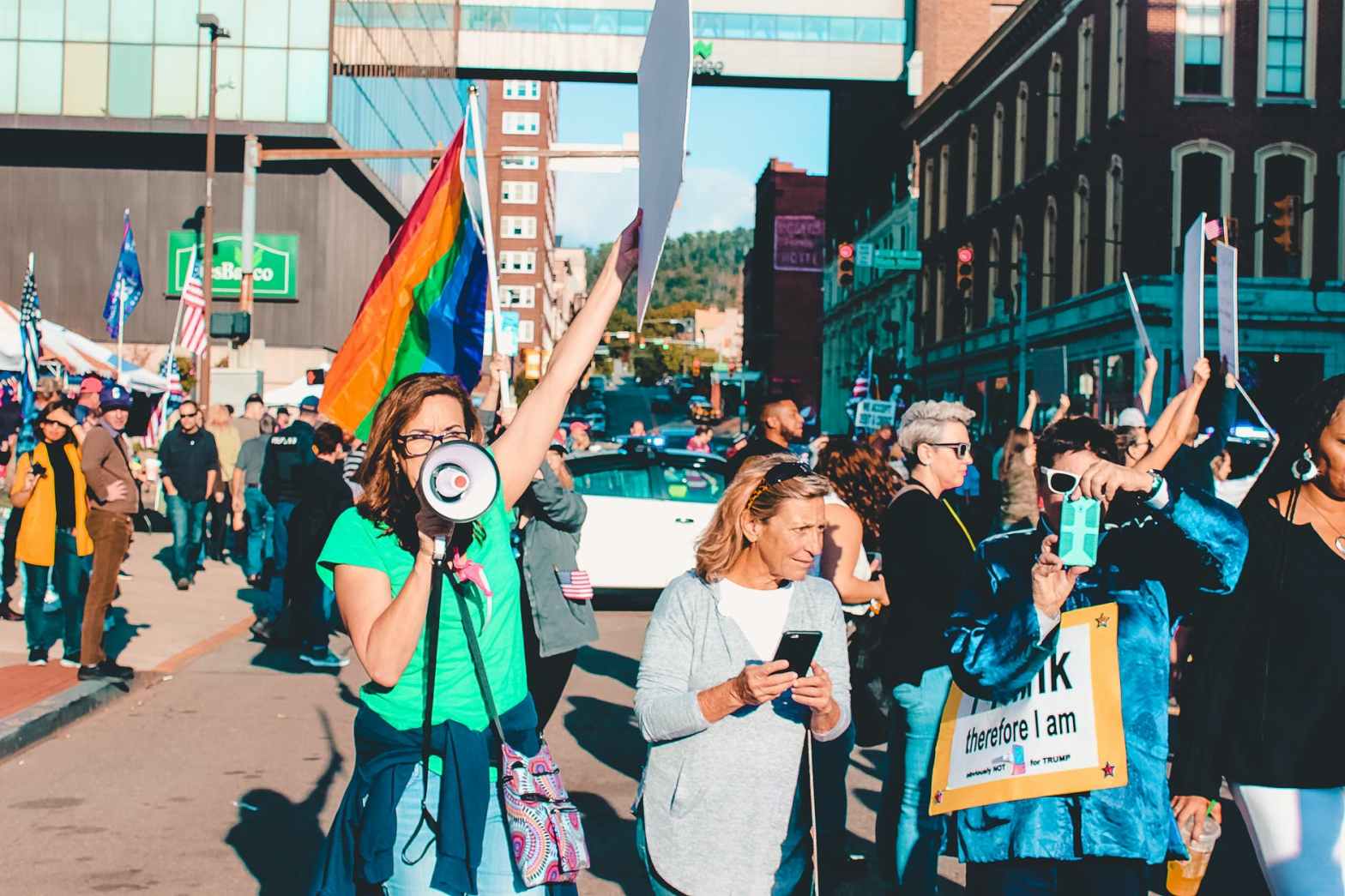
Earlier in life, I took pride in being very political. I didn’t join a specific political party. But, I was openly critical of those who didn’t share my views. And, often this would get ugly.
For some reason, obnoxiousness came naturally to me. If I got it into my head that there was one right way of doing things, I could be very aggressive in pushing my agenda.
It took a lot of hard lessons and damaged relationships for me to view things differently.
Thankfully I had some good mentors, and some very patient friends.
And, looking back on those times, I can see how my aggression and obnoxiousness were actually driven by fear, anxiety, and my perceived need for self-protection.
Behind all this was also a deeply held belief that others could not be trusted.
And here we get to the nub of the issue . . .
When trust is eroded to the point that conversations quickly turn into shouting matches, how can we talk meaningfully about things that matter?
When trust is eroded to the point that conversations quickly turn into shouting matches, how can we talk meaningfully about things that matter?
In this post, I don’t want to give a step-by-step how-to guide on how to rebuild civility. The pessimistic side of me sometimes thinks the world is past the point of no return; civility may, in fact, be a thing of the past.
Be that as it may, I do want to talk about trust.
Why?
Because spirituality, at its core, is concerned with trust.
So, when we can’t trust our neighbours to treat us with respect, kindness, and dignity, this is fundamentally a spiritual problem.
When we can’t trust our leaders to lead with integrity, to embody the virtues of truthfulness, honesty, and justice, this too is fundamentally a spiritual problem.
When we can’t trust the media, scientists, researchers, physicians, and other kinds of experts to further the interests of all humanity, this too is a fundamentally spiritual problem.
Why are these fundamentally spiritual problems?
It’s because when trust is broken, with anyone or anything, this signals a rupture in relationship.
And why does this create problems?
When relationships are ruptured, we feel no obligation to express love, care, or concern. Rather, we feel freer to label, stereotype, and demonize, regardless of whether those we impose these labels, stereotypes, and demonizations upon conform to these characterizations or not.
When relationships are ruptured, we are no longer concerned with discerning the truth of another person or situation.
In such situations, we are no longer concerned with discerning the truth of another person or situation.
Rather, we become concerned only with shoring up our battlements, circling our wagons, and fortifying our rhetorical fortresses . . . for the sake of . . . what?
- Convincing ourselves we’re right?
- Expressing our anger and frustration with the state of the world?
- Absolving ourselves of whatever damage we might do by posting a vicious attack on social media?
- Or . . .?
None of these intentions is connected with healthy spirituality or religion.
Why is this?
Well, I could easily go down the well-worn path of saying that each is driven by the ego and its concerns. I would then also be required to say (almost contractually) that a truly spiritual person is suspicious of the ego. Such people are suspicious of the ego because they want to transcend its concerns to the point of abandoning them almost completely.
But this would do the much-maligned ego a disservice.
Spiritual health is, in fact, dependent on a person having a relatively healthy ego.
This is because a healthy ego enables a person to distinguish between what’s their’s to deal with and what’s others’ to deal with.
In other words, a healthy ego enables a person to establish and maintain healthy interpersonal boundaries. These are, of course, the foundation of healthy interpersonal relationships.
However, anyone can get into trouble when they start to believe that their ego is the sum total of their identity.
When this happens, such a person cannot accept constructive feedback, or any revelations of their potential shortcomings, or any information that does not already conform to the stories they tell themself about themself or about the people in their in-group.
And this is a spiritual problem.
Anyone can get into trouble when they start to believe that their ego is the sum total of their identity.
Why?
A person occupying such a closed stance refuses to believe that there are any true realities beyond their own perspective. They refuse to accept that any person, perspective, or opinion beyond their own can be either correct or true.
In other words, those occupying such closed stances refuse to consider that people and groups beyond themselves might possess truths that require just as much, if not more consideration than the truths they understand themself to possess.
In the emerging international political climate, such a broader sense of truth seems to have become an unnecessary luxury.
Instead, most of us choose only to hear “truths” from those we trust, refusing to realize that truth in any ultimate sense must transcend the perspectives of any specific person or group of people.
No wonder there’s so much conflict in the world today!
Most of us choose only to hear “truths from those we trust, refusing to realize that truth in any ultimate sense must transcend the perspectives of any specific person or group of people.
But here’s where spirituality can offer a solution.
This solution emerges because spirituality is a-political while at the same time being deeply political.
What do I mean by this?
A spiritual person refuses to get caught up in partisan politics. This is so because partisan affiliations limit the perspectives that can be engaged when attempting to act for the good of all–humanity included!
Rather, for spiritual people, the good is discerned through the concreteness of real-life encounters with other people, cultures, groups, nature, and the Ultimate itself.
In other words, the good is discerned in the context of relationship.
And, because spiritual people are deeply aware that they themselves are finite, they are also aware that their own perspectives will always exclude numerous other perspectives, precisely because of their finitude.
So, spiritual people realize that no relationship, nor any network of relationships, can fully capture the sum total of reality.
Truth, then, always lies beyond its specific concrete formulations.
No relationship, nor any network of relationships, can fully capture the sum total of reality.
Anything that expresses a claim to truth, then, becomes an invitation to relationship.
So, when trust is broken and relationships are ruptured, truth cannot be meaningfully established.
Instead, truth becomes a victim of polarization and conflict, and all reality suffers as a result.
Why?
Because we don’t have the secure relational basis to determine the truth about reality in any fundamental or collective sense.
Our capacity to cause damage and harm therefore increases exponentially. This is because our engagements with reality are not grounded in truth. Rather, they are grounded in our own finite perceptions, perceptions that are oriented toward serving our own needs, or the needs of our specific group.
This is why spirituality has the capacity to guide us out of this predicament.
Spirituality has the capacity to guide us out of this predicament.
In its orientation toward relationships, and, in its awareness of human finitude, spirituality advocates for a slow and patient approach when engaging reality.
A spiritual politics thus attempts to get behind the slogans, rhetoric, and polarization, and works to see the faces of the people who hold various opposing positions.
Furthermore, a spiritual politics evaluates policies, parties, and positions on their capacity to build and maintain relationships with everything that is. It is for this reason that no single party, policy, nor position will likely capture the imaginations of those who engage in spiritual politics: none of these things can engage reality in its fullest and truest sense.
Rather, those engaged in spiritual politics will always gesture toward what lies beyond our current policies, positions, and parties.
Why?
Because there is always more to consider; there is always something that will have been missed.
When civility lies behind us and we too easily get stirred up by inflammatory and polarizing rhetoric, we desperately need a politics grounded in relationship, that strives to engage the faces behind the slogans and protests.
In this current situation, no one is innocent and no one is beyond responsibility.
In our current situation, no one is innocent, and no one is beyond responsibility.
Who, then, will have the courage to truly see people as people, all of whom want the best for themselves, for their families, and for the generations who will come after us?
Who, then, will have the courage to be beholden to truth, the truth that is truly true, the truth that transcends and includes all, the truth that beckons everyone and everything into healthy and fulfilling relationships with all that truly is?
A challenging call, to be sure. But it’s becoming more and more urgent.
Why?
Our very future depends upon it.
Disclaimer: The advice and suggestions offered on this site are not substitutes for consultation with qualified mental or spiritual health professionals. The perspectives offered here are those of the author, not of those professionals with whom readers might have relationships as clients or patients. In crisis situations, readers are encouraged to contact these professionals for appropriate support and treatment if needed.
 Reflective Life
Very good Simon – well done. An important piece for people to read today, as we all long for the healing of relationship in our world.
LikeLike
Thanks so much, Sarah!
LikeLike
This one took me a long time to write, but I think it finally settled in a good and helpful place . . .
LikeLike