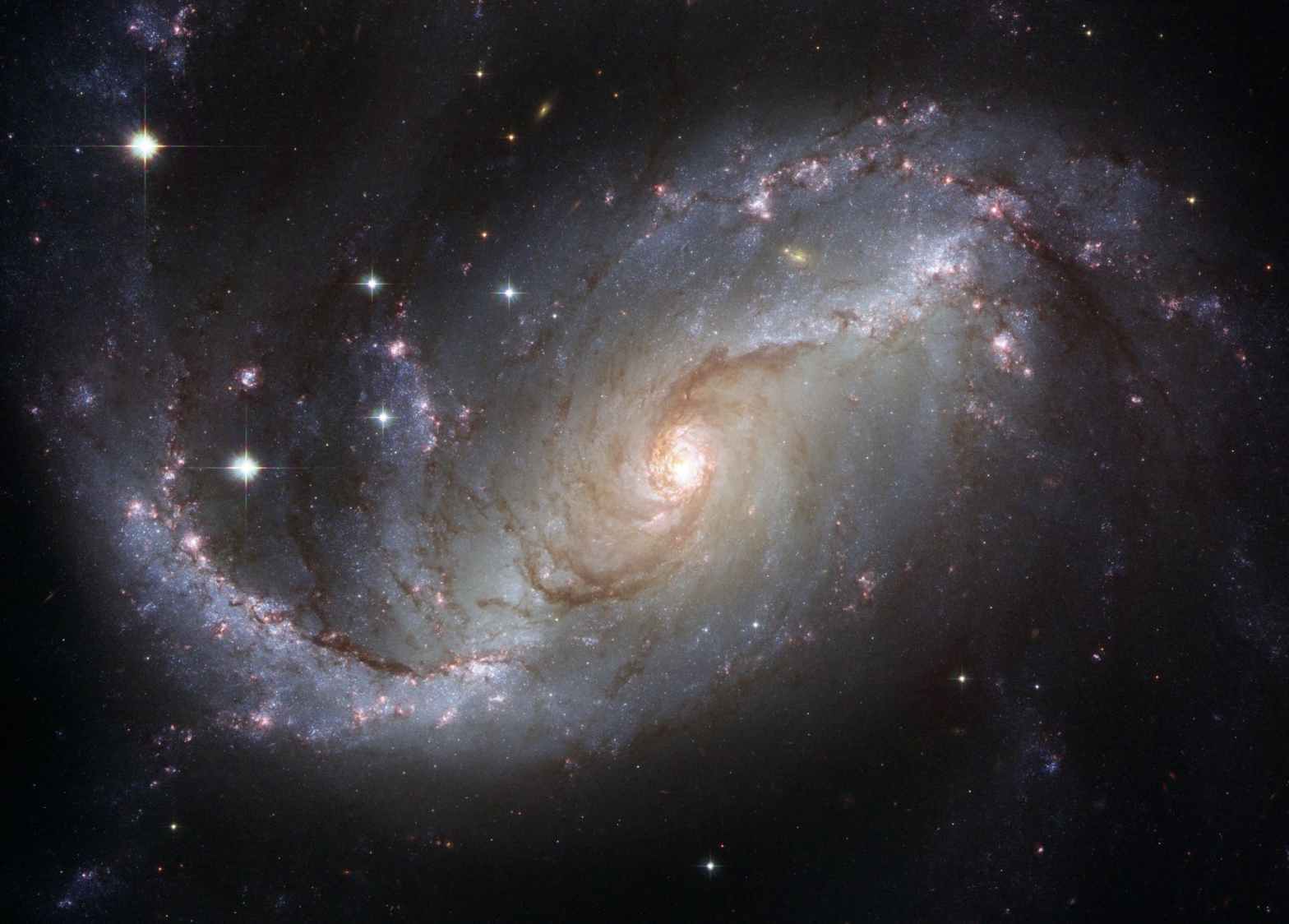
Here we are in the middle of summer. One thing I love about this season is getting outside under a starlit sky, seeing the lights of distant suns, imagining what life might exist beyond the bounds of our planet.
I remember lying on the deck of my family’s cabin one August to view the perseid meteor shower. I had never seen the meteor shower before. You can imagine my awe and wonder seeing the bright lights of alien rocks disintegrating in Earth’s atmosphere shooting directly over my head. That is a night I will never forget.
Often, people use such experiences to express their awareness that there is something out there much bigger than themselves. Who cannot be impressed by the seemingly infinite vastness of outer space? Who cannot be filled with feelings of insignificance in relation to the apparent endlessness of the known universe?
“Who cannot be impressed with the seemingly infinite vastness of outer space?”
Yet part of this human wondering is also trying to capture this infinity, to reproduce these feelings of vastness and insignificance within the confines of mathematical or philosophical formulations.
Somehow, to draw from within one’s self ways to express ultimate reality can be like a mystical experience. Is it any wonder, then, that many scientists and philosophers describe their work in deeply spiritual terms, even though they deny belonging to any spiritual tradition?
While it is true scientists and philosophers can formulate some very profound things, all these are approximations of what reality actually is. In fact, one of the goals of science and philosophy is to revise, undermine, and disprove previous theories concerning the nature of reality. In doing so, scientists and philosophers believe they are moving toward better understandings of life, the universe, and everything. It is therefore debatable whether there will ever be a single definitive statement about what is reality.
“It is debatable whether there will ever be a single definitive statement about what is reality.”
The challenge for a person living a spiritual life is thus to know the difference between truths that will die away at some point, and truths that are absolute.
Yet, ironically, absolute truth has to be experienced, whereas those that die away can be understood as limited attempts to communicate this deeper experience.
The goal of any spiritual practice, then, is to open one’s self to more and more of this absolute reality. But as this openness increases it also becomes more and more difficult to communicate experiences of the absolute to people who have not experienced things similar.
An emerging reality for such people is thus being in touch with a deep awareness of absolute reality while also watching others being caught up in realities or truths that will die away. When seeing others entranced by these relative realities, those in touch with absolute reality often feel a desire to draw people into greater awareness of the absolute.
The dilemma then becomes how best to navigate the practicalities of living in a world of relative realities, while also seeking to live a life in touch with the absolute. Various spiritual traditions respond to this dilemma in different ways.
What is common to many of them is the idea that by embodying a relation with the absolute in a world of relative realities, a person can bring healing to those whose lives are fragmented and torn by the pull of relative realities that pale in comparison to the absolute.
The absolute is thus that which holds all relative realities together; it is that which counterbalances the eternal change of relative realities through the manifestation of timelessness, changelessness, and infinity. The absolute grounds the relative; it is that from which all relative realities emerge.
“The absolute is that which holds all relative realities together through the manifestation of timelessness, changelessness, and infinity.”
To embody a relation with the absolute, then, is to participate in the work of creation, to bring infinite and absolute goodness into a world fragmented and dis-integrated by multiple relative realities. These relative realities might embody partial goods, but in themselves they are not absolute good. The absolute is absolute–that which is relative can only ever embody parts of it.
In the life that a person receives (if they live their life in consistent relation to the absolute) they will hopefully increase their manifestation of goodness, grace, love, humility, compassion, gentleness, kindness, and all the other virtues named by the great spiritual traditions.
In doing so, this person will draw the people around them into greater awareness of and relation with the absolute. Not only will this restore the wholeness and health of these people. But it will also prepare these people to do likewise with those with whom they live and associate.
A lofty calling if ever there was one.
Here are seven questions to help you reflect on your own experiences of the absolute:
- What is the deepest experience you’ve ever had of being drawn into a reality bigger than yourself, if you’ve ever had one? What exactly happened? What did it feel like?
- Have you ever had an experience where everything you thought was true was turned completely upside down? What exactly happened? What did that feel like?
- What did you learn from each of these experiences?
- How did you live differently as a result of them?
- What did you desire or hope for in light of these experiences? How did you persue (or not) these desires or hopes?
- What might have been some negative aspects of these experiences? How did you respond to them?
- How were you changed for better or for worse because of these experiences? How do these changes connect to your deepest desires, if at all?
Feel free to share your experiences in the comments boxes below this post. I’ll be sure to respond and engage you in conversation, I promise.
Disclaimer: The advice and suggestions offered on this site are not substitutes for consultation with qualified mental or spiritual health professionals. The perspectives offered here are those of the author, not of those professionals with whom readers might have relationships as clients or patients. In crisis situations, readers are encouraged to contact these professionals for appropriate support and treatment if needed.
 Reflective Life
WordPress, is a great contributor in this regard. I feel this, from the depths. If people like us can come together, consistently, this can be a conscious world. Not that we become great contributors. We are just specks. But the intention does matter. Thanks for this encouraging post.
LikeLike
Yes, social media has completely redefined how we understand and construct community. Not only does it put us in touch with ideas and people with whom we would never have come into contact previously. But it also enables us to learn from others’ experiences, thus deepening our engagement with our own lives. Yes, we may be but specks, but specks brought together can form a mountain. Thanks for your engagement!
LikeLiked by 1 person
Yes certainly. Well said. These specks are uniting through the medium of social-media and becoming mountains. Thanks for your kind words.
LikeLike